A Second Chance at Life for Ray After a History-Making Procedure at OU Health
- Category: Blog
- Posted On:

Ray Holliday knew something was wrong.
Walking left him feeling out of breath. His legs were swollen. Some days, he barely left his apartment in Checotah, Oklahoma.
And with every doctor’s appointment, the news seemed to get worse.
Ray had already been turned away by two hospitals. After years of living with a heart condition, the leaky heart he had been warned about as a child was failing. Now in his late 50s, his heart had grown so large, that the standard fixes wouldn't work.
Open-heart surgery was considered too risky. The standard catheter-based valve replacement wouldn’t fit his anatomy.
"They told us he wouldn't survive the surgery," said Cindy Farley, Ray's longtime friend, who drove him to doctor's appointments and fought alongside him for years to find someone who could help. "They flat out turned him down."
It seemed like there was no option left.
But there was.
Making History in Oklahoma City
In late 2025, a team of heart specialists at OU Health, the University of Oklahoma's academic health system, found a way to help Ray by performing a rare procedure that had only been done once before.
Without opening his chest, doctors placed two Medtronic Harmony™ transcatheter pulmonary valves — among the largest artificial heart valves available — into the arteries carrying blood from Ray's heart to his lungs.
The procedure, known as bilateral transcatheter pulmonary valve placement, uses thin, flexible tubes inserted through small openings near the leg and neck. Doctors guide the tubes into the heart and position the valves exactly where they need to be. Ray was awake and alert within hours.
"I just sat in the hospital and thought, times have really changed," Ray said with a laugh. "When I was a kid, I always figured heart surgery meant they had to crack open your chest. I didn't know technology had changed like this."
Based on a review of published medical literature, only one other recorded case of this kind of procedure being performed has been found, placing OU Health University of Oklahoma Medical Center among just two medical centers globally to have performed it.
A Heart Condition from the Start
Ray's journey with heart disease began at birth.
He was born with a defect in his pulmonary valve, the valve that controls blood flow from the heart to the lungs. When he was a boy growing up in California, he had major heart surgery. His doctors told him it had been fixed but warned him the repair might not last forever.
"My doctor told me that eventually, as I got older and matured, that valve was going to start to fail," Ray said. "He prepared me for it, but you never really know when it's going to happen."
The answer came about four years ago, when symptoms began catching up with him. The leaky valve was allowing blood to flow backward. His heart worked harder and harder to compensate, and, as a result, it grew larger and larger.
Cindy, who has known Ray for more than 10 years through her job at a local bank, watched it happen up close.
"He was really not himself," she said. "He was out of breath a lot. His legs were swelling. He was just not living his life the way he should have been."
The Doors That Closed
Finding help was not easy.
A doctor in Tulsa suggested a hospital in St. Louis for open-heart surgery, but that was not a realistic option. The cost was too high, and the travel was more than Ray could manage.
An Oklahoma City specialist examined Ray and said his heart was too weak. Open-heart surgery and time on a heart-lung bypass machine, could be fatal. Ray was already in renal failure. His diabetes added more risk. His obesity made everything harder.
"They told us to maybe look for another doctor, but they didn't think we'd find one," Cindy said.
They didn’t let that low point stop them from looking anyway.
The Doctor Who Said Yes
During this time, Ray was taken by ambulance to a hospital in Muskogee, Oklahoma. The doctor who treated him knew of a cardiologist at OU Health in Oklahoma City — Dr. Anjan Shah, M.D., head of OU Health's adult congenital heart disease (ACHD) program and associate professor at the University of Oklahoma College of Medicine and.
The ACHD program treats adults who were born with heart defects. The most comprehensive program of its kind in Oklahoma, OU Health pairs a cardiologist and a heart surgeon, which breaks down the separation of medical management and surgical intervention for a more integrated plan. For Ray, that combination would turn out to be everything.
"Dr. Shah was different," Cindy said. "He actually listened. He looked at all of it and said, 'I think there is something we can try.'"
Dr. Shah brought in interventional and structural cardiologist Dr. Subhrajit Lahiri, MD, FAAP, FSCAI, FPICS, an OU Health specialist in complex catheter-based cardiac procedures and assistant professor at the University of Oklahoma College of Medicine Together, they studied Ray's case.
The Idea That Changed Everything
The problem with Ray's heart came down to size and shape. Normally, doctors replace a failing pulmonary valve by placing a single catheter valve in the main pulmonary artery, the large vessel just above the heart that splits into two branches heading toward the right and left lungs. Think of it like a T-shape, with the valve going in the vertical part of the T.
But Ray's main pulmonary artery had grown too large. No available valve was big enough to fit.
Then Dr. Lahiri came across a case report from Iowa, where a doctor had tried something different. Instead of placing one valve in the main artery, he had placed a valve in each of the two branch arteries, the left and right sides of the T. Two valves instead of one, each in a smaller, more manageable space.
It had worked. Once.
"I read that paper and I thought, maybe this is the only way he can get his valves," Dr. Lahiri said. "I actually called the doctor in Iowa. I didn't know him. I just found his number and called him and said, ‘tell me how you did it.’"
But Ray's case was much harder due to his existing renal failure and other high-risk conditions. Placing valves in the branch arteries also came with new dangers. Those arteries fan out into many smaller branches in the lungs. If a valve was placed even slightly off, it could block those smaller arteries and cut off blood supply to parts of the lungs.
One millimeter in the wrong direction could cause serious harm.
Planning the Impossible
This is where OU Health's depth of resources made the difference.
Dr. Lahiri worked with OU Health's cardiac imaging team, which processes close to 1,000 cardiac CT scans every year. The team, led by cardiologists who specialize in advanced 3D heart imaging, built a detailed virtual model of Ray's heart from his CT scans. Then, before touching a single catheter, the team rehearsed the entire procedure inside that digital model.
They placed the valves virtually, rotating and adjusting them, looking at every angle to make sure nothing would be blocked that shouldn’t be.
"We did a 3D reconstruction and looked at exactly how the valves would sit," Dr. Lahiri said. "We made sure nothing would be blocked. And it looked like it was going to fit very well. So, we called Ray and told him, ‘we think we can get you two valves instead of one.’"
Ray and Cindy listened carefully as the team explained what they wanted to try. It had only been done once before. It was considered off-label, meaning the valve was being used beyond its original design. But it was the best option Ray had. Maybe his only option.
"We were excited," Cindy said. "Scared too, yes. But we were excited. Because Ray needed this."
The Day of the Procedure
When the day came, Ray went into the hospital, and the team followed the plan they had rehearsed so many times in the digital model. They threaded the catheters into position. They deployed the first valve into the right branch pulmonary artery, then the second into the left. Both valves seated exactly where the virtual simulation had shown they would.
No blocked arteries. No complications. Just two new valves doing exactly what they were supposed to do.
"It worked out just like we planned," Dr. Lahiri said. "When you have done the preparation and the imaging, and then you see it happening just as you expected, it's a really good feeling."
Ray barely had time to process what had just happened before he was up and moving around. His recovery was faster than any of them expected.
"He was up and going in no time," Cindy said. "The doctors were wonderful. The nurse staff also treated Ray so well. No complaints at all."
A Different Man Today
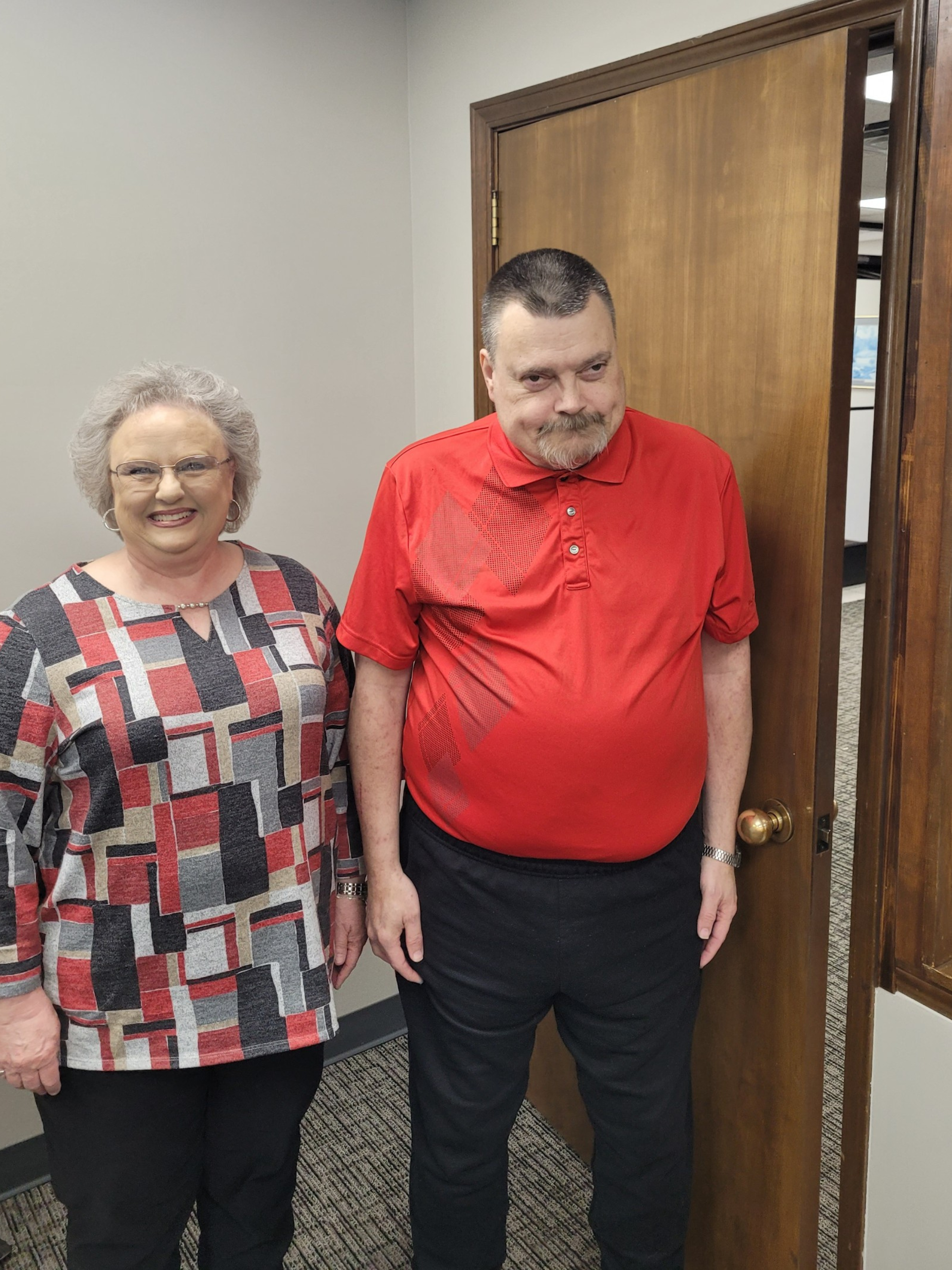 Not long after the procedure, Ray walked into Cindy's bank.
"He was walking easily and looking good," she said. "His coloring was better. You could just see the difference."
Ray, who turned 58 not long after the procedure, is not one to make a fuss. When asked how he feels, he keeps it simple.
"I just want to thank the team for what they did for me," he said. "I'm living."
Cindy, who had her own quadruple bypass surgery years ago, knows firsthand what long recovery looks like and sees the bigger picture.
"I am totally amazed," she said. "If they can do something that makes it easier on the patient to recover, instead of cracking them open, I think that is wonderful. And if this can help anybody else, I am just thrilled."
What It Means for Oklahoma
Dr. Lahiri says the population of patients who might benefit from this approach is relatively small, but for those patients, the impact can be life changing. Of the 40 or so patients a year who need a pulmonary valve replacement, there may be one whose condition doesn’t fit the standard options because of an enlarged heart or other conditions that make surgery too dangerous.
Before this procedure became possible, those patients often faced devastating choices. They could travel out of state and hope to get into a clinical trial, wait for an option to come along, or go without treatment and watch the heart slowly fail.
Now there is a new option.
"We will [consider this procedure for] any patient who comes to us in this situation," Dr. Lahiri said. "This will become a standard option for that particular patient population. We know how to do it now."
The OU Health team is preparing a medical publication to share what they learned so other cardiologists around the country can benefit from their experience. The device manufacturer has already reached out asking for details.
And for patients across the state who are facing complex heart conditions and have been told their options are limited, the message from OU Health is a direct one:
"OU Health is here to find a way when other options run out," Dr. Lahiri said. "That is what we do."
For Ray Holliday of Checotah, Oklahoma, that was not just a line. It was the difference between life and whatever came next.
And right now, he is living.
Learn more about adult congenital heart care at OU Health or call (572) 244-0079.
.png)