Stage 4 Colon Cancer Survivor Finds Hope Through Clinical Trial Care at OU Health
- Category: Blog
- Posted On:
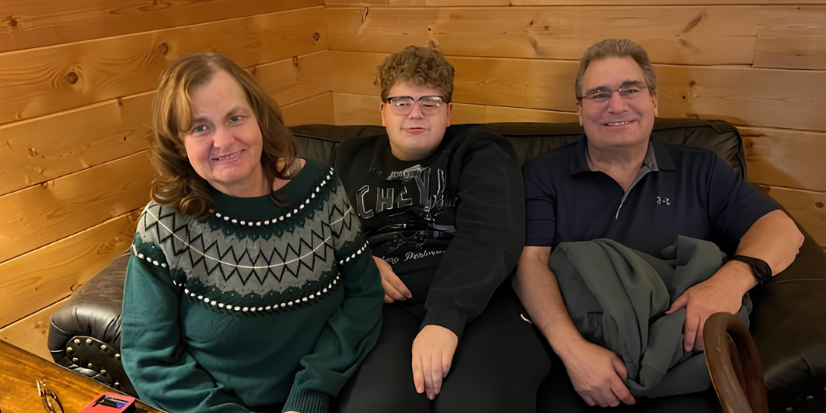
By the time Kim Woodward learned she had colon cancer, it had already spread to her liver, her lungs and the lining of her abdominal cavity. The doctors gave it a name: Stage 4 colorectal cancer.
Her husband, Kevin, whose mother had died of the same disease, was terrified. Kim, who lives in Coyle, Oklahoma, was 56 with a son named Steven, then 14, at home.
She did not intend to give up.
"I have to see Steven's 40th birthday," she remembers thinking. "He's 16 now. I knew everything was going to work out, and it has."
Today, after enrolling in a Phase I clinical trial at OU Health Stephenson Cancer Center, part of the University of Oklahoma's academic health system, Kim is approaching something that felt impossible not long ago. She is nearly cancer-free. The last visible remnant of her disease is a single speck on one lung, smaller than a grain of sand.
"I'm going to be cancer free," she said, her voice carrying the quiet certainty of someone who has already survived what most people cannot imagine.
A Diagnosis Hidden in Plain Sight
Kim’s illness did not announce itself the way most people expect cancer to. For months, she experienced what felt like recurring urinary tract infections, a burning, urgent discomfort that sent her to the doctor repeatedly. The cultures kept coming back negative with no infection or clear cause.
A doctor finally ordered scans. They revealed a tumor wrapped around her ovaries, and an initial diagnosis of ovarian cancer led her to undergo surgery at an area hospital.
During the operation, however, the surgical team discovered the primary source of the cancer was not her ovaries at all. It was her colon. Surgeons removed her ovaries, her appendix and resected her colon, taking out two areas of hardened tissue later confirmed to be the origin of her disease.
It was, by then, already Stage 4. The cancer had traveled through her bloodstream.
The Turning Point: Molecular Profiling
Kim and her husband had been preparing to travel out of state for treatment when they learned the facility was out of network for their insurance. With that option closing, they returned to her oncologist, who had trained at OU Health, in search of more options.
The oncologist ordered molecular profiling of Kim’s tumor, a genetic analysis of the cancer's unique biological fingerprint. The results revealed something important. Kim carried a rare mutation. And that mutation made her eligible for a clinical trial at OU Health Stephenson Cancer Center.
Director of the Phase I Clinical Trials Program at Stephenson Cancer Center, Dr. Susanna Ulahannan, M.D., MMed, associate professor in the Section of Hematology/Oncology at the University of Oklahoma College of Medicine, said molecular profiling should be standard for every patient with metastatic cancer, though it remains far from universal.
"Every patient with cancer needs to have molecular profiling," Dr. Ulahannan said. "If you have metastatic cancer, there is no excuse to not have molecular profiling done. Some of these mutations are very rare, but if you have them, it's life-changing because of the targeted options that you may have. That's exactly the story here."
In October 2024, Kim met Dr. Ulahannan and enrolled in the Phase I trial. She was, her doctor said, a strong candidate for a combination approach, pairing one medication designed to target her specific genetic mutation and prevent cancer cells from dividing and spreading and the second one preventing resistance and increasing efficacy.
Results That Stunned Even Her Doctor
The response was swift and, by almost any measure, astonishing. Within months, the lesions that had appeared across Kim’s lungs and liver began to disappear. Her scans, cycle after cycle, brought good news. Dr. Ulahannan showed her imaging that traced where the cancer had been, empty circles marking the space where tumors once lived.
"They are not there anymore," Kim said. "It's just invisible circles around where my lesions used to be."
Her most recent scans showed the single remaining spot on her lung had shrunk from 0.05 centimeters to 0.04 centimeters. It is now, as she put it, nothing more than a speck.
Dr. Ulahannan said the response reflects precisely why targeted therapy and clinical trials represent the future of cancer care, we need to find better options for our patients with treatments that work and provide great quality of life.
"She's traveling. She's going on a cruise. She's working full time," Dr. Ulahannan said. "And she looks amazing."
Why Clinical Trials Matter in Oklahoma
OU Health Stephenson Cancer Center runs approximately 48 active Phase I trials at any given time, with 244 open trials across early and late phase portfolios, making it one of the most active Phase I programs in the country. The center draws patients from across Oklahoma, as well as from Arkansas and Missouri, offering access to advanced therapies that simply do not exist elsewhere in the region.
For Kim, that proximity was everything. Without this clinical trial available in Oklahoma, her only option would have been to travel out of state, and that’s if her insurance would have covered her treatment.
"Without clinical trials, we won’t find new and better treatments," Dr. Ulahannan said. "And we would never have new drugs that would benefit others."
This is OU Health's tripartite mission made visible. Patient care is delivered at the bedside, research is conducted in the laboratory and the clinic, and education filters through every layer of care at the University of Oklahoma's academic health system.
The Case for Colon Cancer Screening
Kim’s story also carries an urgent public health message. Her cancer masqueraded as something far more ordinary for months before anyone thought to look deeper. The delay may have cost her the chance at an earlier, more treatable diagnosis.
Colorectal cancer rates are rising among younger Americans, and the American Cancer Society now recommends that people at average risk begin screening at age 45. Colon cancer caught early, when it is still localized, has a five-year survival rate exceeding 90%. At Stage 4, that rate drops sharply.
But screening is only the first step. For patients diagnosed with colorectal cancer, treatment does not end with successful surgery. Ongoing surveillance is essential.
Dr. Ulahannan said ongoing surveillance, even after successful surgery, can be the difference between a cure and a recurrence that goes undetected until it is too late.
"Don't just lose follow-up once surgery is done," Dr. Ulahannan said. "Follow up afterwards is equally as important. Do the molecular profiling. Cancer treatment is very fine-tuned now based on molecular profiling. It's not one size fits all."
Kim’s own research played a role in her willingness to try the trial. She had learned that her specific type of colon cancer was resistant to certain standard chemotherapy, a fact that made the prospect of traditional treatment even more daunting. The clinical trial, with its targeted approach, felt like the better wager.
"I was willing to take the chance that this would work for me," she said. "I wanted to live."
Her Family at Stephenson Cancer Center
The clinical care Kim receives at OU Health Stephenson Cancer Center has been, by her account, as much an emotional lifeline as a medical one. Her care team, including her Nurse Practitioner Jennifer Rios and the nurses she calls by name, have become something close to family.
"Dr. Ulahannan, my nurses and my nurse practitioner are my family now," Kim said. "I just love them so much. They love me and Kevin so much. Anything new that's bothering me, they always try to figure [out] something to do next."
Even in the early weeks of the trial, when she developed severe mouth sores and a skin reaction that looked like a chemical burn, the team kept adapting, finding new mouth rinses and adjusting her protocol until the side effects were manageable.
She is staying on the trial. Leaving it would mean forfeiting her spot, and with a response this strong, neither she nor Dr. Ulahannan see any reason to stop. The goal now is not just survival. It is the kind of life Kim always intended to have.
"I'm so lucky to be alive," she said. "And I'm alive because of the OU Health doctors who came into my life."
For information about clinical trials at OU Health Stephenson Cancer Center, part of the University of Oklahoma's academic health system, call (405) 271-8778.
.png)