Former OU Football Coach Gary Gibbs Fights Back Against Blood Cancer With Help From OU Health Stephenson Cancer Center
- Category: Blog
- Posted On:

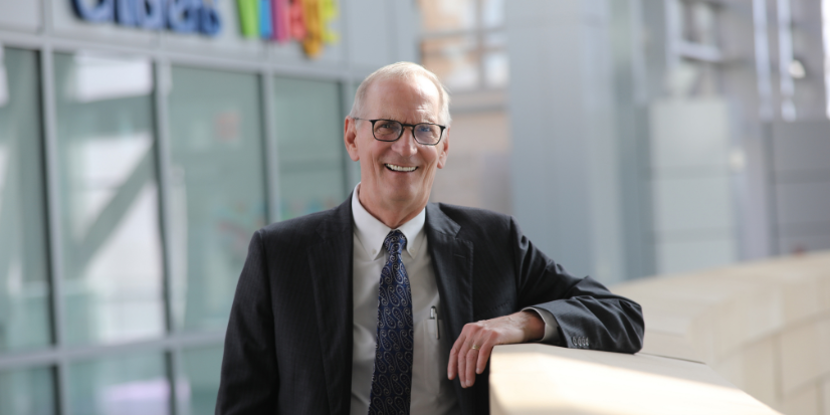
Gary Gibbs has spent a lifetime on the sidelines, guiding players through high-pressure moments on football fields across Oklahoma and beyond. But in 2018, the former University of Oklahoma head coach faced the most formidable opponent of his career.
It was not a rival team, but multiple myeloma — a blood cancer that would test his resilience in ways no game ever could.
Today, thanks to the specialized care he received at OU Health Stephenson Cancer Center, part of the University of Oklahoma's academic health system, Gary is back on his feet. He is on a treadmill, spending time with his grandchildren, and looking forward to the future.
OU Health Stephenson Cancer Center is the only facility in Oklahoma that performs allogeneic stem cell transplants and the only one in the state with the expertise to treat complex post-transplant complications. That distinction made all the difference in Gary’s long-term health.
"The people at Stephenson Cancer Center are just great people," Gary said. "We're grateful. Every time I've been there, I've never left without feeling not only comfortable but grateful."
The Long Game Ahead
Gary's medical journey began during a routine physical in 2018. A urine test revealed irregularities that eventually led to a diagnosis of multiple myeloma. His local oncologist recommended he see OU Health bone marrow transplant specialist Dr. Jennifer Holter-Chakrabarty, M.D., professor of medicine in the section of hematology-oncology and an adjunct associate professor of radiation oncology.
Multiple myeloma is a cancer of the plasma cells, which are part of the immune system. In a healthy body, plasma cells produce a variety of antibodies to fight infection. In multiple myeloma, a single plasma cell begins making copies of itself uncontrollably, crowding out healthy cells in the bone marrow.
After several rounds of chemotherapy in spring 2019, Gary underwent an autologous stem cell transplant at OU Health Stephenson Cancer Center in July of that year. In that procedure, doctors harvested Gary's own stem cells, administered high-dose chemotherapy to destroy the cancerous cells, and then reinfused the healthy stem cells to rebuild his bone marrow.
"No one told me how tough it would be," Gary said. "I thought I'd be watching ESPN and eating Popsicles. But the nurses there were not just good; they were great. They made the biggest difference during those 22 days in the hospital."
The transplant sent Gary into remission, and for a time, he was doing well. But his previous chemotherapy treatments had taken a toll. By late 2023, Dr. Holter-Chakrabarty identified a new concern.
Gary had developed myelodysplastic syndrome (MDS), a condition in which the bone marrow fails to produce healthy blood cells. MDS can result from prior chemotherapy and, if left untreated, can progress to acute leukemia.
Because MDS originates in the bone marrow itself, Gary could not use his own stem cells again. He needed an allogeneic stem cell transplant, which uses cells from a donor.
After further chemotherapy to bring the MDS under control, Gary underwent the donor transplant in March 2025. In a stroke of good fortune, a 29-year-old donor from overseas was a 100% match.
"That is not totally uncommon, but there are a lot of people we know who never had a 100% match," Gary said.
Finishing the Game Strong
While Gary received his second transplant at another facility, Dr. Holter-Chakrabarty and the team at Stephenson Cancer Center managed his ongoing care once he returned to Oklahoma. The two medical teams communicated closely throughout his treatment, and by September 2025, Gary's out-of-state doctor told him he no longer needed to travel for follow-up visits. He expressed full confidence in Dr. Holter-Chakrabarty and her team.
That confidence was well placed when Gary developed graft-versus-host disease (GVHD), a serious complication in which the donor's immune system attacks the recipient's body. He also developed a rare and dangerous condition called transplant-associated thrombotic microangiopathy (TA-TMA), which causes the breakdown of blood cells and abnormal clotting.
Dr. Holter-Chakrabarty drew on her deep expertise and her connections to leading transplant centers across the country to manage both conditions.
"We have five practitioners who do bone marrow transplant and cellular therapy, and that's all they do," Dr. Holter-Chakrabarty said. "We have not only the expertise here, but the connections to centers outside Oklahoma where we can pick up the phone and have an expert on the line at any given moment."
Using an advanced medication that had recently been shown to be effective in treating TA-TMA alongside GVHD, Dr. Holter-Chakrabarty was able to bring both conditions under control.
Now, years after his first transplant and approaching the anniversary of his donor transplant, Gary is doing well. Dr. Holter-Chakrabarty said that most patients who are going to relapse would have done so by this point.
"Gary's back to walking on a treadmill, getting to play with his grandkids, and getting to travel," Dr. Holter-Chakrabarty said. "He's certainly back to living a more normal life again."
Getting Back on the Playing Field
For Gary, the experience has reinforced a philosophy that served him well on the football field: You have to get up every day, even when the odds are long.
"There are a lot of days you don't want to get up, and you have to get up," Gary said. "You can't do this without a great caregiver. I wouldn't be here without my wife Jeanne."
He also hopes his story will encourage other Oklahomans to seek advanced care close to home rather than assuming they need to leave the state for the best treatment.
"The coordination between Dr. Holter-Chakrabarty and my other doctors, the teamwork and commitment, that's what makes it all happen," Gary said. "I've been a recipient of a lot of help, and I hope this can help other people going through the same thing."
Dr. Holter-Chakrabarty also urged Oklahomans to consider registering as bone marrow donors, particularly younger individuals and those from diverse ethnic backgrounds, who are critically underrepresented in the national donor registry.
"The person who gave cells to Gary is someone who, out of the kindness of their heart, gave bone marrow cells and traveled and took the time to do that," Dr. Holter-Chakrabarty said. "Because they took the time out of their lives, Gary's alive today. I can't put it any more clearly than that."
Learn more about bone marrow transplants, cellular therapy and other advanced treatments at OU Health Stephenson Cancer Center or call (405) 271- 1112.