Beating Burkitt Leukemia: Thatcher’s Fight Against Childhood Cancer

At just 7 years old, Thatcher Severin’s world changed overnight. What began as a week of unexplained vomiting and a swollen belly quickly escalated into a medical emergency. After a visit to the local doctor on October 25, 2024, and a rushed trip to the emergency room, Thatcher was transferred to Oklahoma Children’s Hospital OU Health. A series of tests confirmed a devastating diagnosis — Thatcher had cancer.
Thatcher, from Goltry, Oklahoma was immediately placed in the pediatric intensive care unit (PICU). He had surgery to place a port for cancer treatment, as well as a bone marrow biopsy and lumbar puncture. The test results revealed that Thatcher had a type of aggressive cancer called Burkitt leukemia.
What is Burkitt Leukemia?
Burkitt leukemia is a rare and fast-growing blood cancer that starts in a type of white blood cell called a B-cell. It happens when these cells grow out of control in the lymph nodes (lymphatic organs around the body) and spread to the bone marrow (the soft center of bones where blood cells are made). This form of leukemia is most common in children and teens, and it needs quick treatment because it can grow very fast.
People with Burkitt leukemia often feel very tired, weak, or dizzy because their bodies aren’t making enough healthy blood cells. They may get infections more often, have fevers, or bruise and bleed easily. Some may also have bone pain, a swollen belly, or swollen lymph nodes. Since it spreads quickly, doctors usually treat it right away with strong chemotherapy and medicine to protect the brain and spine from the cancer spreading there.
How Do You Treat Burkitt Leukemia?
Thatcher had a buildup of malignant (cancerous) fluid in his lungs and stomach, which was causing his belly to swell. The medical team drained the fluid using chest tubes and then started Thatcher on an initial three courses of chemotherapy designed to be gentler on his body. Because his body was storing extra fluid, he couldn’t take the more intense chemotherapy medicines he needed until he was stronger.
A month after Thatcher’s diagnosis, his intestines ruptured. He had an emergency surgery to remove the damaged part of his bowel. To give his intestines time to heal, he also had an ileostomy — a procedure that creates a small opening in the belly (called a stoma) so waste (poop) can leave the body into a bag.
“It was a terrifying time,” said Thatcher’s mother, Jordan. “The only goal at that point was for Thatcher to survive the surgery — nothing more.”
Thatcher made it through the surgery and spent a couple of weeks recovering in the PICU.
On December 20, just before Christmas, Thatcher was able to go home to spend the holiday with his family. While at home he developed a fever and had to return to Oklahoma Children’s Hospital. Thatcher had neutropenia — a condition where your body has fewer neutrophils than normal.
What is Neutropenia?
Neutrophils are a type of white blood cell that helps fight off infections, especially from bacteria. When neutrophil levels are low, the immune system becomes weaker, making it easier to get sick. This condition is often caused by things like chemotherapy, certain infections, or bone marrow problems. People with neutropenia may not have symptoms at first, but if it becomes severe, even everyday germs can lead to serious infections.
In January, Thatcher had a procedure to place a stent in the common bile duct near his gallbladder. (A stent is a small tube that allows bile to flow from the liver to the intestines, where it helps digest food.) He spent four weeks in the hospital and then began the standard six rounds of aggressive chemotherapy at the Oklahoma Children’s Hospital OU Health Jimmy Everest Center. He was under the care of pediatric hematologist/oncologist Dr. Kisha Beg, M.D., assistant professor in the Department of Pediatric Hematology/Oncology at the University of Oklahoma College of Medicine.
The Jimmy Everest Center
The Jimmy Everest Center, named after an inspiring teenager, was established 30 years ago. It provides comprehensive care for children with cancer and blood disorders.
Thatcher’s chemotherapy treatment followed a 28-day cycle.
“Each chemotherapy cycle typically lasts three to five days, but due to the intensity of chemotherapy and risk of a severe, life-threatening infection, patients often remain hospitalized for up to a month for close monitoring,” said Dr. Beg. “That was the case for Thatcher.”
Dr. Beg explained that at first, Thatcher would stay in the hospital until his body was strong enough to go home. After that, he would only need to stay for three to five days each time, then he was able to go home for a few weeks before the next treatment. Sometimes, Thatcher had to go back to the hospital because of infections and problems from his stomach surgery.
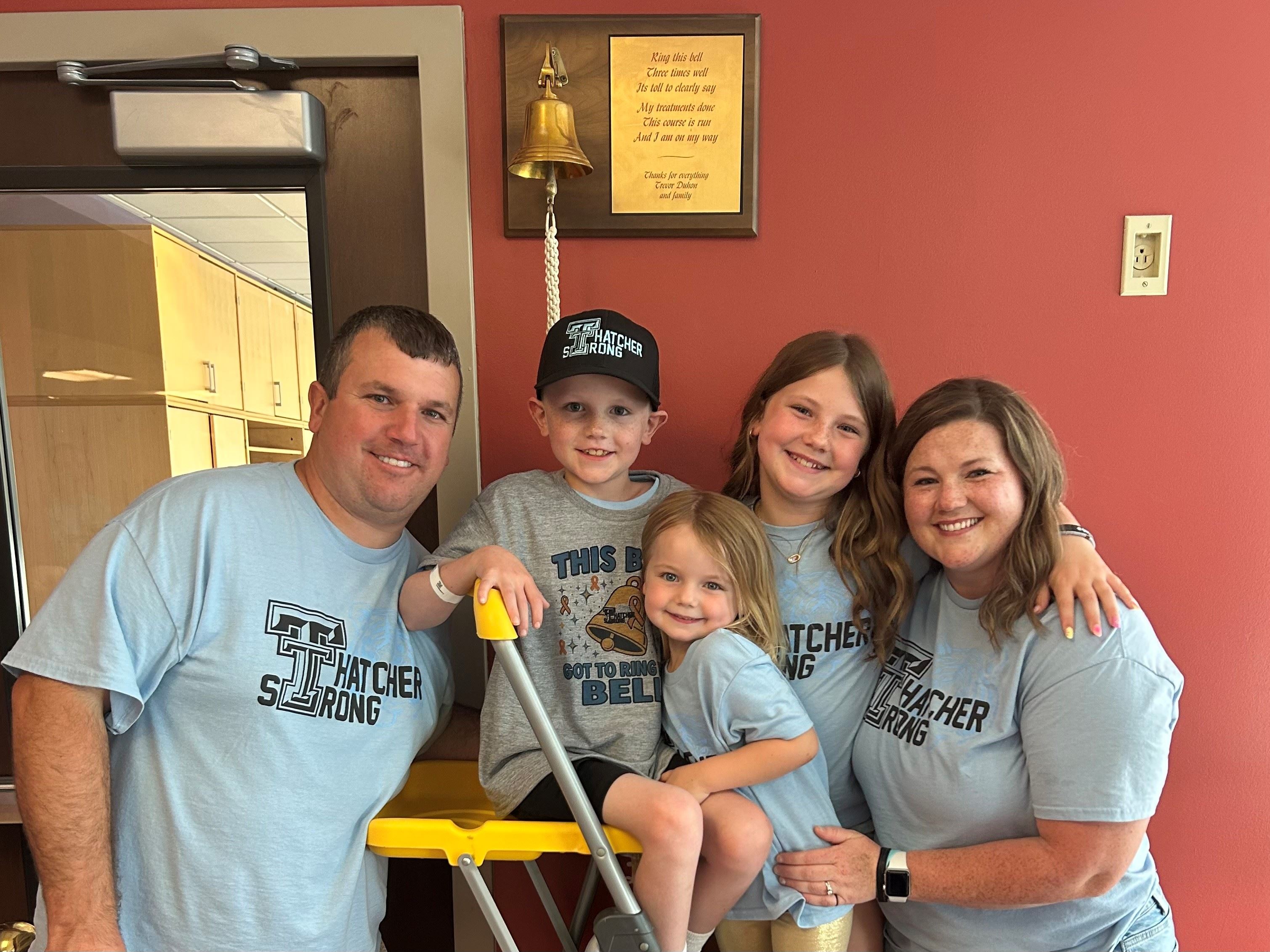
Sports-lover Thatcher received his last dose of chemotherapy at home on April 5 so he could attend a flag football tournament in his honor.
“Thatcher adores his beloved Timberlake Tigers high school football team, and his dad, Tyler, is the assistant coach,” said Jordan. “Our school district is very small which means we know each student. Thatcher loves going to football games, basketball games, baseball games, track meets, and basically any event we attend so he can see his friends and the older athletes who influence him greatly.”
 Loving Life
Thatcher responded quickly to cancer treatment. A bone marrow biopsy and PET scan at the end of his treatment showed no signs of cancer.
He will soon have surgery to remove his gallbladder and port, and a procedure to reverse his ileostomy. The surgeons will reconnect the intestines and close the opening in the belly (stoma). After this, poop goes through the body the normal way again, and there’s no need for a bag.
Thatcher is back to enjoying life. He’s passionate about OU football, hunting, fishing, and anything that gets him outside — whether it’s running with his dogs, swimming, golfing, or helping at the family farm with the cattle and wheat harvests. He’s also a sharp gamer, a Pokémon card collector, and a music lover. Despite missing most of the school year for cancer treatment, Thatcher has managed to maintain exceptional grades, scoring in the top 5% nationwide. He’s a loving brother to Jayli and Jovie, and his favorite way to show affection is teasing! Thatcher’s love language is laughter.
“The entire care team at Oklahoma Children’s Hospital and the Jimmy Everest Center is exceptional,” said Jordan. “Dr. Beg is always so responsive and knowledgeable and we are so grateful for the way everyone cared for Thatcher.”
Jimmy Everest Center’s 30th Anniversary
Celebrating 30 years of hope and healing, the Jimmy Everest Center stands at the forefront of pediatric cancer care in Oklahoma. Your support does more than treat illness; it fuels groundbreaking research, provides comfort to families, and ensures every child receives the most advanced, compassionate care possible. Every gift brings us closer to a future where no child faces cancer alone.
By supporting the Jimmy Everest Center, you help extend our reach, advance lifesaving treatments, and inspire hope in children and families across Oklahoma and beyond. Join us in shaping a brighter tomorrow for pediatric cancer care.
Learn more about the Jimmy Everest Center or donate today to make a lasting impact on the lives of children fighting cancer.