A Race Against Time: Tate’s AVM Rupture and the Multidisciplinary Team That Saved His Life
- Category: Blog
- Posted On:

At 8 years old, Tate Baldwin from Edmond, Oklahoma has always been full of energy. His love for adrenaline-filled activities like riding his four-wheeler and dirt bike on the family acreage keeps him constantly entertained. But that changed over Christmas break in 2024. At Monday night basketball practice Tate complained of a severe headache, and then he started to vomit. His mother, Kristi, was not surprised — Tate’s 12-year-old sister had recovered from a stomach bug the week prior. However, by Friday, Tate had not only failed to improve but was far worse. He had a sore neck, a severe headache, and was still throwing up.
“It was around 1 p.m. that Tate told me he felt like he was dying and couldn’t feel his legs,” said Kristi. “We headed straight to an emergency room in Oklahoma City. I explained his symptoms, thinking he was dehydrated, but he also had a headache and neck pain. His neck had locked in a position.”
The medical team acted quickly, starting him on an IV, and doing a range of tests. Tate was taken for a CT scan. Ten minutes later the emergency doctor informed Kristi that her son was being transported to Oklahoma Children’s Hospital OU Health. Tate had a brain bleed, and the swelling was causing intense pain.
Once Tate reached Oklahoma Children's, the neurosurgery team was waiting. An additional CT scan with dye confirmed that Tate had an arteriovenous malformation (AVM), and it had ruptured at some point.
As the only physician in Oklahoma trained in both open pediatric neurosurgery and pediatric endovascular neurosurgery — a rare training combination held by only 20–30 specialists nationwide — Dr. Michael Feldman, M.D., took over Tate’s care. Dr. Feldman is also an assistant professor in the Department of Neurosurgery at the University of Oklahoma College of Medicine.
What is Arteriovenous Malformation?
AVM is a cluster of blood vessels that are tangled up in the wrong way, where arteries connect directly to veins without the usual small vessels (capillaries) in between. This can cause blood to flow too fast and with too much pressure and may damage the vessels and make them prone to bursting. This can lead to problems like bleeding in the brain, seizures, or headaches. AVMs are usually there from birth and most people are not aware they have them until something goes wrong.
On Saturday, Jan. 11, Tate was placed under anesthesia for a diagnostic angiogram. Dr. Feldman threaded a catheter through the arteries of Tate’s neck and into his brain to inject contrast dye. This showed the flow of blood through the blood vessels to help identify high-risk features and plan his surgery.
Dr. Feldman consulted with cranial neurosurgeon Dr. Christopher Graffeo, M.D., M.S., who has deep expertise in open vascular techniques. Dr. Graffeo is also a professor in the Department of Neurosurgery at the University of Oklahoma College of Medicine.
“Usually, AVMs are monitored after a rupture, but Tate’s AVM was large and complex,” explained Dr. Feldman. “The AVM had features that suggested a high risk of further bleeding. The team decided that immediate surgical intervention was necessary to remove the AVM.”
A Complex Surgery Begins
AVM surgery is high risk and requires a large team of experts from across medical disciplines. It involves detailed planning and preparation, and Dr. Feldman was working to build a team of experts who would give Tate the best chance in surgery.
While Tate waited for surgery, he underwent hourly neurological checks to monitor his condition. The medical team had to ensure Tate was awake and responsive to avoid hydrocephalus, a related condition in which the brain’s plumbing system can get blocked, leading to dangerously high pressure. It was a difficult time for Tate and his family. Not only did he endure severe pain from the AVM, but he was unable to get solid sleep.
“We stayed with Tate every moment, and by the time his surgery day came we were exhausted,” said Kristi. “Tate understood how significant the surgery was, and he expressed his fear of dying. That was hard, but we reassured him that Dr. Bossman (our nickname for Dr. Feldman), wouldn’t let that happen.”
On Jan. 14, Tate was given medication to help him sleep until the afternoon surgery. It was a nervous time for the Baldwins, but they knew that Tate was receiving the best possible care under a team of experts.
“We said goodbye to Tate at 1:47 p.m.,” said Kristi. “They wheeled him to the operating room, and we didn't see him again until 12:45 a.m. A nurse called me every hour with updates, and we were relieved when we were told that the surgery was over, and Tate was being closed up.”
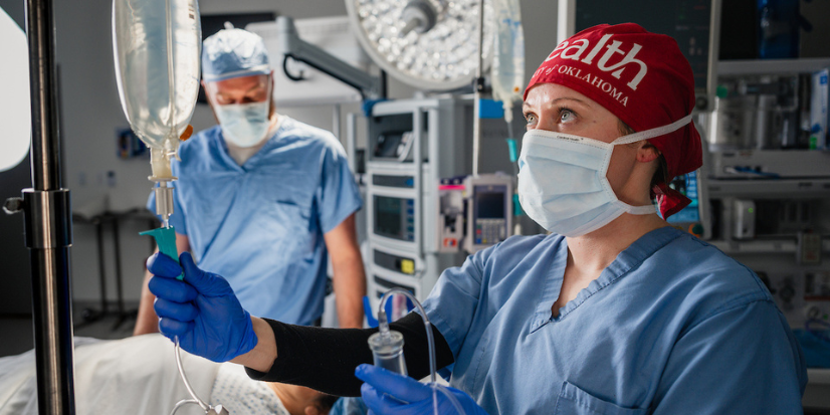
Dr. Feldman’s team temporarily removed a piece of Tate’s skull to access his brain (a craniotomy) and get to the AVM. When the AVM was exposed, the aneurysm they had been concerned about burst, leading to life-threatening amounts of blood loss from Tate’s brain. Fortunately, by this point Drs. Graffeo and Feldman were already looking at the AVM and were able to get the bleeding under control. A rapid and coordinated response followed, with multiple anesthesiologists, nurses, and OR staff rushing into the operating room to assist.
“Thanks to the expertise of the surgical team, particularly Dr. Graffeo’s skill in vascular control, we were able to clip the bleeding artery,” Dr. Feldman explained. “The anesthesiologists immediately started Tate on blood transfusions and that helped save his life.”
Back on His Feet, Back to Being a Kid
After the surgery, Tate was taken to the angiography suite. The follow-up angiogram showed that the AVM had been completely removed.
During the bleeding in surgery and efforts to get it under control, Tate had a stroke. It initially left him with some weakness on his left-side, and vision problems. After 19 days in the ICU and almost six weeks in rehabilitation, he has made incredible progress. Tate can walk and is back to his active lifestyle.
Dr. Feldman confirmed that Tate’s prognosis is optimistic. He is expected to return to a largely normal life, including, hopefully participating in the sports and other activities he loves. Tate is back home, enjoying life just being a kid.
“At Tate's six-week check-up, he walked up to Dr. Feldman and thanked him for saving his life,” said Kristi. “It was a touching moment that brought us all to tears. Dr. Feldman was so honest and supportive throughout the surgery, and it helped us cope with a really difficult situation. We are so thankful for the entire team who worked so hard to save Tate’s life.”
Expert Care for the Most Complex Cases
At OU Health, complex conditions like AVMs are treated by expert teams from multiple specialties who work together to create personalized care plans. This collaborative approach ensures even the most high-risk cases, like Tate’s, receive advanced, compassionate care every step of the way.
Learn more about our pediatric neurosurgery program and how we can make a difference in your child’s care and future.