Recognizing Stroke Warning Signs in a Young Adult and the Rapid OU Health Care That Saved Her Life
- Category: Blog, Adults Services
- Posted On:
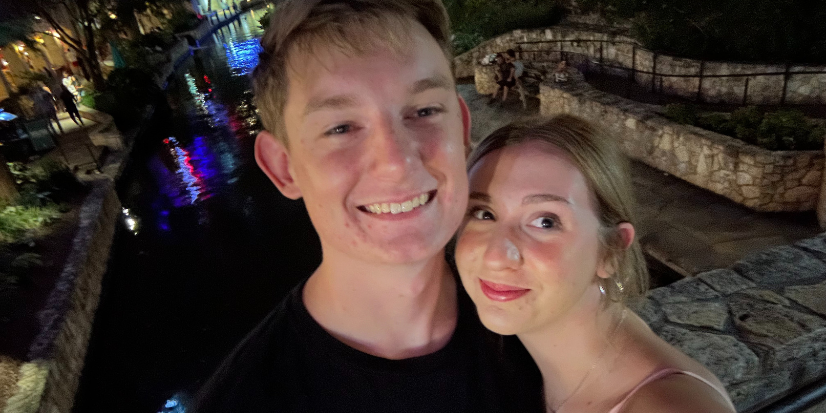
When 20-year-old Alyson Hatfield settled onto the couch with her husband, Jake, on a quiet Friday afternoon in late October, nothing felt unusual. She’d spent the morning at home, feeling perfectly healthy, talking with Jake about plans for the evening and where they might go for dinner. Nothing hinted at what was about to unfold.
Jake glanced over and noticed something was wrong. Only one side of Alyson’s smile lifted. The other side stayed completely still. She began to drool. Her words became jumbled. A sharp headache struck one side of her head. Alyson reached for her phone to text her sister, but the words came out as gibberish.
“I thought I was talking normally,” she said. “I had no idea I wasn’t making sense.”
Jake asked her to repeat a simple phrase, and she couldn’t. He immediately called 911.
“I kept telling him, ‘I’m fine,’” Alyson said. “But I wasn’t.”
In This Story, You’ll Learn
- The stroke warning signs Alyson’s husband recognized
- What happens when the OU Health stroke team is alerted
- How clot-busting medication and mechanical thrombectomy work
- Why a stroke can occur even in young adults
- What a PFO is and why it matters
- How Alyson’s birth control pill may have played a role in her stroke
- Alyson’s recovery and next steps
A Rapid Response When Every Second Counts
Paramedics arrived within minutes. They asked Alyson to lift her left arm and leg, but nothing moved, even though she was trying.
“I remember thinking I was doing it,” she said. “I didn’t understand why my body wasn’t responding.”
Because the paramedics suspected a stroke, they activated a stroke alert from Alyson’s home in Oklahoma City. That alert mobilized the OU Health stroke team, led by neurologist, Dr. Jorge Ortiz-Garcia, M.D., associate professor in the Department of Neurology and Chief of the Section of Critical Care Neurology at the University of Oklahoma College of Medicine, before she even arrived.
“We knew she was coming,” said Dr. Ortiz-Garcia. “The team was ready. With stroke, time truly is brain.”
Alyson arrived at OU Health University of Oklahoma Medical Center at 1:09 p.m. By 1:25 p.m., she had received the clot-busting medication.
“They said everything was going to move fast, and it did,” Alyson said. “But everyone was so kind. There was a stroke coordinator who stayed with me the whole time. She made me feel safe.”
She was taken immediately for a computed tomography (CT) scan. The scan confirmed an ischemic stroke — a blockage in a major artery of the brain. She needed to have an emergency surgery.
Emergency Treatment: Clot-Busting Medication and Thrombectomy
Alyson needed two urgent treatments:
1. IV Clot-Buster (Tenecteplase)
This medication dissolves the clot from the inside out.
“It restores blood flow and prevents permanent brain damage,” Dr. Ortiz-Garcia explained.
2. Mechanical Thrombectomy
Neurosurgeons placed a catheter through a tiny incision in Alyson’s groin and navigated to the blocked artery in her brain to physically remove the clot.
“It’s like an angiogram,” Dr. Ortiz-Garcia said. “We go directly to the artery, pull out the clot, and reopen the vessel.”
Within 60 minutes of arrival, the clot was gone, and the blood vessel was open.
A Remarkable Recovery
When Alyson woke up, she didn’t realize that the surgery was already over, until she saw the stroke coordinator’s reaction.
“She looked at me and said, ‘Look at you,’” Alyson said. “Your whole smile is back.”
The improvement was immediate.
On arrival at the hospital, Alyson scored a 3–4 on the NIH Stroke Scale, indicating significant impairment. The NIH Stroke Scale is a tool doctors use to assess the severity of a stroke. Scores range from 0 (no symptoms) to 42 (very severe). A score of 3–4 means Alyson had mild to moderate impairment, such as weakness, speech issues, or vision problems.
One hour after treatment she scored 0, indicating full neurological recovery.
“She had an early and significant response,” Dr. Ortiz-Garcia said. “Her prognosis is excellent.”
Why Did This Happen? The Unexpected Role of a PFO
Because Alyson was only 20 and had no typical stroke risk factors, the team searched for a cause.
They found two possibilities:
1. Oral Contraceptive Pills (OCPs)
Some birth control pills containing estrogen can increase the risk of clotting.
“We advised her to stop the oral contraceptive immediately and follow up with her OB-GYN,” said Dr. Ortiz-Garcia.
2. A Patent Foramen Ovale (PFO)
A PFO is a small hole between the upper heart chambers. Normally it closes after birth but in about 1 in 4 adults, it stays open.
Dr. Ortiz-Garcia explained that a clot can pass through a PFO, bypass the lungs, and travel straight to the brain. In young patients, this is a known cause of stroke.
Alyson will now see a cardiologist to determine whether her PFO should be closed with a minimally invasive procedure.
Understanding the Treatment Steps
What Happened, Step by Step
- Stroke Alert Activated: Paramedics recognized the signs of stroke and alerted OU Health before arrival. The stroke team was ready the moment Alyson reached the emergency room.
- Rapid Imaging: A quick CT scan shows whether a blood vessel in the brain is blocked or bleeding and determines the right treatment. CT scans confirmed Alyson had a vessel blockage.
- IV Tenecteplase (Clot Buster Medication): A medicine given through the vein that dissolves the clot from the inside and reopens blood flow to the brain. This is administered within 16 minutes of arrival.
- Mechanical Thrombectomy: Neurosurgeons insert a small tube from the groin up to the brain and carefully remove the clot from a brain artery to restore blood flow.
- Neuro ICU Monitoring: Specialists closely monitor brain function, blood pressure, and recovery in the only neuroscience ICU in Oklahoma, staffed by neurologists and neurosurgeons.
- Stroke Unit Recovery + Evaluation: Once stable, patients move to the stroke unit for therapy and additional testing to determine the cause and support long-term recovery. For Alyson, this included therapy, heart ultrasound, vascular studies, and risk-factor workup.
Healing and Processing a Stroke at 20
Alyson stayed in the hospital for five days — not because she was physically debilitated, but for additional testing and monitoring.
She remembers her nurses as especially comforting, and she appreciated Dr. Ortiz-Garcia showing her the imaging and explaining exactly what happened.
“I really felt cared for,” Alyson said. “Everyone was so kind.”
She has made an extraordinary recovery and can now cook, walk, clean, and manage daily life. She still experiences mild fine-motor challenges in her hand and occasional anxiety, especially if she gets a headache.
“It’s still hard to believe it happened,” she said. “Every day we say, ‘Wow, it’s crazy I had a stroke.’ I’m only 20. It’s a lot to process.”
Her husband remains protective, especially when she’s pushing herself at home. Her father, who lives in Ohio, was devastated when he learned what happened as he was so far away from her. Knowing she is now doing so well is a relief.
Despite what she endured, Alyson still looks ahead with hope.
“I still want all the same things for my life,” she said. “This didn’t take that away.”
Expert Insights from Dr. Jorge Ortiz-Garcia
As the fifth-leading cause of death in Oklahoma and the United States, and the leading cause of disability, stroke affects about 800,000 people in the United States each year.
Stroke can happen at any age
“This case is a powerful reminder that stroke is not just a disease of the elderly,” he said. “Young adults — even children — can experience stroke, often due to unique risk factors.”
Know the Signs of Stroke: BE FAST
The BE-FAST acronym will help you identify the main stroke symptoms:
- B: Balance - Sudden loss of Balance
- E: Eyes - Sudden loss or changes in Eye vision
- F: Facial drooping – One side of the face may droop or feel numb
- A: Arm or leg weakness – Difficulty raising one arm or leg that drifts downward
- S: Speech difficulties – Slurred speech or trouble speaking
- T: Time to get help immediately – call 911 and note the time when the person last seemed normal
If you or a loved one experiences these signs, act quickly in seeking medical treatment by calling 911. Every second counts.
Alyson’s outcome improved because her husband recognized the signs quickly and called 911.
“Recognizing symptoms early can mean the difference between full recovery and lifelong disability.”
Why Rapid Treatment Saved Alyson’s Life
“Early recognition and immediate treatment are critical. She received clot-busting medication within minutes and a thrombectomy within the treatment window. That’s why she recovered so quickly.”
OU Health for Specialized Stroke Care
“OU Health provides 24/7 stroke treatment, AI-assisted imaging, Oklahoma’s only neuro-ICU run by neuro-critical care and neurosurgery specialists, and a dedicated stroke unit,” said Dr. Ortiz-Garcia. “We have all the resources needed for rapid diagnosis, treatment, and recovery.”
Learn more about specialized stroke care, neurosciences, and the Comprehensive Stroke Centerat OU Health University of Oklahoma Medical Center in Oklahoma City, including achievement such as American Heart Association’s Get With The Guidelines®Stroke Gold Plus with Target: Stroke Honor Roll-Elite Plusand Advanced Therapy and Target: Type 2 Diabetes Honor Roll.