Christmas Eve Crash Survivor: Why Level I Trauma Care Made All the Difference in Kaden’s Recovery
- Category: Blog
- Posted On:

Every morning, Kaden Cummings wakes up with a singular goal: to walk again. The 19-year-old from El Reno, Oklahoma, drives himself to physical therapy five days a week, determined to regain movement in his legs after a life-changing car crash on Christmas Eve 2024 left him partially paralyzed.
“I believe God helps those who help themselves,” Kaden said. That faith — paired with his positive attitude and relentless work — has pushed him to regain strength in his back, obliques, and most abdominal muscles. He has also regained sensation down to his feet, a feeling that gets stronger each week.
The night of the crash, emergency responders rushed Kaden to the Level I Trauma Center at OU Health University of Oklahoma Medical Center. His survival and prospects for meaningful recovery hinged on the quick, expert care he received.
Everything Changed in an Instant
On December 24, 2024, Kaden was driving home from his girlfriend’s house after spending Christmas Eve with her family. Though he had taken a nap before the 30-minute drive home, the warm car and foggy conditions left him drowsy.
“I remember I was praying as I was going across some railroad tracks, and that’s the last thing I remember,” Kaden said. “Then I woke up in the hospital a few days later in [the] ICU.”
Police reports confirmed that Kaden had fallen asleep at the wheel. His 2008 Ford Focus hit a guardrail, launched into the air, and landed upside down in a creek bank. He was going about 60 miles per hour when the crash happened.
Emergency crews cut Kaden out of his small car. At 6 feet, 3 inches tall, Kaden’s large frame sustained severe injuries in the compact vehicle. He was transported to the Level I Trauma Center at the University of Oklahoma Medical Center, where a specialized trauma team was waiting.
Lifesaving Care at the Level I Trauma Center
When Kaden arrived, doctors quickly assessed the extent of his injuries. He had two brain bleeds, a collapsed lung, four broken ribs, and a broken back. Most seriously, his spinal cord was crushed at the T5 level, just below his chest.
“He was severely injured, and it was very obvious when he arrived that he had a spinal cord injury because he wasn’t able to move his extremities,” said OU Health trauma surgeon Dr. Emily Switzer, M.D., assistant professor in the Department of Surgery at the University of Oklahoma College of Medicine. “Because of that, he was having a hard time breathing.”
Doctors immediately put Kaden on a breathing machine. Trauma surgeon Dr. Chance Nichols, M.D., assistant professor in the Department of Surgery at OU College of Medicine, said the young man’s injuries affected multiple body systems.
“These multisystem trauma patients can be complicated,” Dr. Nichols said. “There’s a lot of injuries that we have to diagnose and prioritize to make sure we're not missing anything.”
Critical to Kaden’s survival was the Level I Trauma Center at the University of Oklahoma Medical Center, verified by the American College of Surgeons Committee on Trauma. This means the hospital meets the highest national standards for treating severely injured patients, and it can provide total care for every aspect of injury — from prevention through rehabilitation.
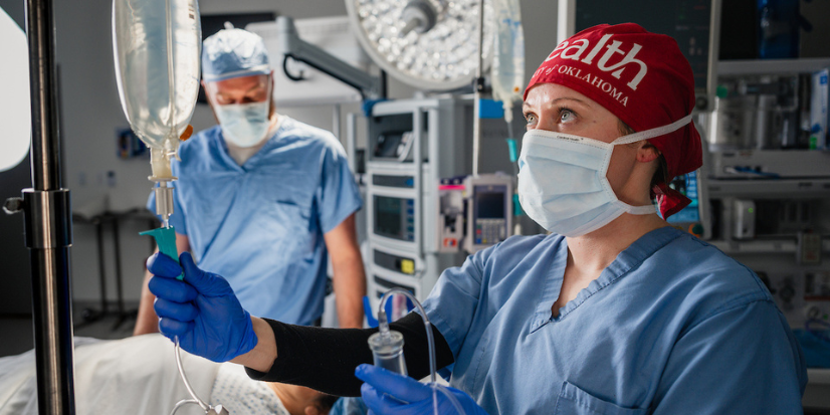
Patients like Kaden have 24/7 access to on-site doctors in virtually every specialty, including 10 trauma surgeons who also provide ICU care. In addition to specialized nurses, the trauma team includes radiology technicians, respiratory therapists, rehabilitation therapists, social workers, mental health professionals, chaplains, and more.
“We have immediate availability of all surgical subspecialties, operating room availability, and a lot of ancillary staff,” Dr. Nichols said.
Two Weeks of Intensive Care
Kaden spent two weeks in the trauma ICU and was kept sedated while his body began to heal from his severe injuries.
During this time, he developed serious complications. While on the ventilator, he got staph, strep, and pneumonia infections all at the same time. Doctors placed a tracheostomy tube to help him breathe and to gradually wean him off the ventilator. (A tracheostomy tube goes through the windpipe, bypassing the mouth and nose for breathing.)
“Our trauma ICU nurses are very special,” Dr. Switzer said. “They provide truly around-the-clock, minute-to-minute care for these patients and their families.”
One ICU nurse in particular formed a special bond with Kaden — one that continues today.
“Kevin is such a good, caring nurse,” Dr. Switzer said. “I’m not surprised that he has created bonds like that with his patients.”
The Road to Recovery Through Faith
After a month and a half, Kaden was transferred to Craig Hospital in Colorado for three months of intensive therapy. The hospital specializes in neurorehabilitation for individuals with spinal cord injuries. There, he learned how to live with his new situation and began working to regain his strength.
Kaden had lost significant weight during his hospital stay, dropping from 190 pounds to 158. His rehabilitation focused on rebuilding strength and teaching him daily living skills.
Now back home, Kaden continues his recovery with determination. He does pool therapy, works with electrical stimulation on his legs, and receives various treatments to reduce inflammation and improve blood flow.
His positive attitude has impressed his medical team.
“He was so optimistic and really like, ‘I’ll do it.’ Nothing was too hard,” Dr. Switzer said. “I think that has gone a long way for him and his recovery.”
Looking Forward to the Future
Kaden plans to attend Oklahoma State University in the spring to study finance while continuing his therapy. He drives himself to appointments and maintains his independence.
“I’m taking it one day at a time, pushing forward, and getting back to walking,” Kaden said.
His story shows how the specialized care available at a Level I Trauma Center can make the difference between life and death, and between a meaningful recovery and permanent disability. The coordinated approach — trauma surgeons, ICU specialists, and dedicated nurses working seamlessly — gave Kaden the best chance at recovery.
For families facing similar traumatic injuries, Kaden’s experience underscores the critical importance of having access to the highest level of trauma care when every minute counts.
When every second counts, trust the trauma care that sets the standard. OU Health is Oklahoma’s only academic health system and one of the nation’s few hospitals verified by the American College of Surgeons as a Level I Trauma Center for both adults and children. From disaster response to lifesaving innovation, our trauma experts lead with research, education and unmatched clinical care — because excellence isn’t optional.
To learn more about the Level I Trauma Center at the University of Oklahoma Medical Center and the ways patients benefit from its specialized care, visit OU Health Emergency Care.