A New Beginning: How a Bone Marrow Transplant Helped Cale Olbert Reclaim His Life
- Category: Blog
- Posted On:
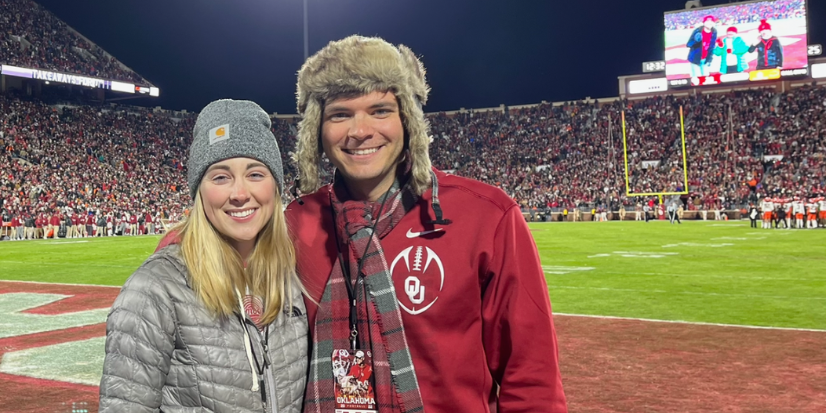
When 32-year-old Cale Olbert started feeling run-down in summer 2024, he thought it was just a lingering cold. He’d recently bought a house with his fiancée, Lauren, and was working full-time in finance. He’d also spent the previous weekend golfing with friends.
“I had a low-grade fever and sore throat that wouldn’t go away,” Cale said. “I thought maybe I’d been burning the candle at both ends.”
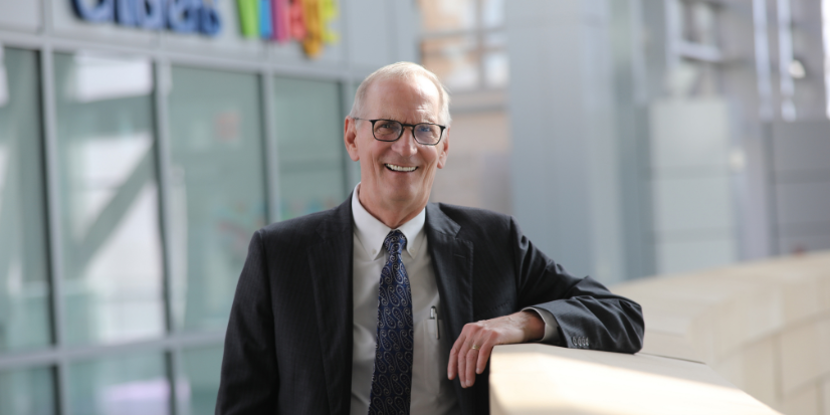
A follow-up blood test soon changed everything. When Cale’s results showed severe abnormalities, his doctor referred him to OU Health Stephenson Cancer Center, where hematologist-oncologist Dr. Adam Asch, M.D., professor of medicine and chief of the Division of Hematology-Oncology at the University of Oklahoma College of Medicine, ordered a bone-marrow biopsy. Cale was diagnosed with acute myeloid leukemia (AML) — an aggressive blood cancer that requires immediate treatment.
A day later, Cale and Lauren went to the courthouse in Norman and got married.
What Is Acute Myeloid Leukemia (AML)? Understanding the Disease
AML is a fast-growing cancer of the blood and bone marrow, the soft tissue inside bones where blood cells are made. In AML, the marrow begins producing large numbers of abnormal white blood cells called myeloblasts. These immature cells crowd out healthy ones, leaving the body unable to make enough normal red cells, platelets, or infection-fighting white cells.
Because leukemia spreads through the blood, it doesn’t have “stages” like solid tumors do. Instead, doctors focus on how aggressive the disease is and how well it responds to chemotherapy. Symptoms often include fatigue, fever, frequent infections or bruising easily, all of which are signs that healthy blood production has been disrupted.
“AML is a systemic disease,” Cale said. “It’s not just in one place. It’s everywhere at once.”
Starting Treatment at OU Health Stephenson Cancer Center
Within days of diagnosis, Cale began intensive induction chemotherapy at OU Health Stephenson Cancer Center, designed to destroy the cancer cells in his bone marrow. The treatment worked and by September 2023, he was in remission, meaning his bone marrow showed no detectable leukemia cells.
However, remission didn’t mean cure. AML is notorious for returning unless the diseased marrow is replaced.
“The doctors told me chemotherapy could buy me time,” Cale said, “but the only real treatment was a bone marrow transplant.”
He completed two additional maintenance cycles of chemotherapy in the fall of 2024, then prepared for transplant at Stephenson Cancer Center, home to Oklahoma’s only comprehensive bone marrow and stem-cell transplant program.
“One thing I remember clearly is the day before Cale’s admission he and Lauren got married so she could care for him during treatment,” said Dr. Asch. “We actually delayed admitting him so they could go to the courthouse. It was a beautiful moment at the start of a difficult journey.”
World Class Care Without Leaving Oklahoma
At first, Cale and his family considered whether they should travel out of state for care.
“When you hear ‘leukemia,’ you think maybe MD Anderson or somewhere like that,” he said. “But a family friend who’s a doctor told us, ‘Stay home. Go to OU Health. You’ll get world-class care here.’”
“Our program is the best in the state at treating acute leukemia and offering curative transplants,” Dr. Asch said. “The best chance at a permanent remission comes when we evaluate early and move appropriate patients to transplant in their first remission. We’re always happy to see Oklahomans for consultation at any point.”
How a Bone Marrow Transplant Works
Cale had an allogeneic stem cell transplant, which means he received healthy stem cells from a donor whose tissue matched his, to help treat the AML and rebuild his immune system. These donor cells also helped fight the cancer by attacking any remaining cancer cells in his body.
Most donors don’t undergo surgery. Instead, they receive several days of injections that stimulate the bone marrow to release stem cells into the bloodstream. Then, through a process called apheresis, blood is taken from the donor, stem cells are separated out and the remaining blood is returned to the body.
In late November 2024, Cale began conditioning therapy — high-dose chemotherapy that destroyed his existing marrow and suppressed the immune system, making room for donor cells to engraft. The transplant itself was performed during an inpatient stay at OU Health University of Oklahoma Medical Center. In early December, he received an IV infusion of donor stem cells — a process that looks a lot like a blood transfusion.
“The idea is that once those cells are in your bloodstream, they travel to your bones, take root, and start making new, healthy blood,” Cale said. “In my case, that took about a week and a half.”
The First 100 Days After Transplant: Recovery and Risk
The first 100 days after transplant are the most critical, as the immune system rebuilds and adjusts to the donor’s cells. During that time, patients are at heightened risk of infection and must take strict precautions.
“Preparative regimens wipe out the marrow for about three weeks until donor cells start working,” Dr. Asch said. “Even after white cells return, the new immune system takes months to learn to recognize and fight viruses and fungi. That’s why the early months at home still require caution.”
The moment the donor cells began producing healthy blood (called engraftment) came quickly for Cale. He had a few brief hospital stays for minor infections, including the flu, but otherwise, things went as smoothly as he could have hoped.
By early 2025, his blood counts had stabilized. Follow-up bone marrow biopsies at 30-and 100 days post-transplant showed full donor chimerism, meaning that all Cale’s blood cells now came from his donor. Even his blood type changed to match.
“I was O positive before,” he said. “Now I’m A positive, which is my donor’s type. It’s wild to think about.”
Rebuilding Immunity Following a Bone Marrow Transplant
Because transplant recipients lose their previous immune memory, they must restart childhood vaccinations to rebuild protection against disease.
“It’s an almost two-year schedule of re-immunization,” said Dr. Asch. “We also follow donor-derived immune cells as a fitness measure; Cale’s are 100% donor, which is exactly what we want to see.”
Fatigue and stamina improve gradually, usually between eight months and a year. Dr. Asch explained that medications used to prevent infection and guard against graft-versus-host disease (a condition where donated cells attack the recipient’s tissues after a transplant) can also contribute to feeling less than 100% early on.
For the first six months, Cale stayed home, avoiding crowded places and had limited social contact, to minimize infection risk. He’s now back to living life more like he used to.
“I’m about 80 percent back to normal now,” he said. “I’m back at work part-time, getting out more and starting to do the things I love again.”
Expert Care and Teamwork at OU Health
Throughout treatment, Cale marveled at the seamless teamwork at OU Health.
“My dad’s a retired physician, and he was amazed at how well everyone worked together,” he said. “If something came up — a fever, a rash, anything — the oncologists, infectious-disease doctors and hospitalists were right there, working as a team.”
That collaboration gave Cale confidence.
A Future Full of Possibility
Now in full remission, Cale is excited for the future he once feared he might not have. He and Lauren are also planning a proper wedding celebration.
“We got married at the courthouse in Norman so she could be there for me,” he said. “Now that I’m healthy, we’re planning a real party.”
He looks forward to traveling again, returning to Thunder and OU football games and spending more time on the golf course.
The Gift of a Donor
Cale doesn’t know his donor personally, only that he’s a young man somewhere in Europe — possibly Germany, but he thinks about him often.
“My donor gave me a whole new immune system and a second chance at life,” he said. “He’ll never know how much that means.”
Donor matches are found through national and international registries that connect patients with volunteers around the world.
Advanced Cancer Care at OU Health Stephenson Cancer Center
The OU Health Stephenson Cancer Center Bone Marrow Transplant Program is Oklahoma’s only comprehensive transplant center, offering state-of-the-art care for patients with leukemia, lymphoma, multiple myeloma and other blood disorders. The program provides every stage of treatment — from chemotherapy and immunotherapy to transplant, recovery and long-term survivorship — all under one roof.
By bringing together expert hematologists, transplant specialists, and an entire multidisciplinary support team, OU Health gives Oklahomans like Cale access to world-class cancer care without having to leave home.
“I didn’t have to go to another state to get the best care in the world,” Cale said. “I got it right here in Oklahoma.”
Learn more about Oklahoma’s only blood and bone marrow transplant program at OU Health Stephenson Cancer Center, call (405) 271-4022 to speak to our team, or request an appointment or second opinion.