From Dirt Bikes to Determination: Caleb's Recovery at Oklahoma Children's Hospital OU Health
- Category: Blog
- Posted On:

The afternoon sun filtered through the trees on the Brumley family’s 20-acre property in Choctaw, Oklahoma. Thirteen-year-old Caleb and his father, Brandon, were going for a casual ride on their dirt bikes, suited up in their protective gear, helmets secure. Lindsey Brumley, Caleb’s mother, stood on the porch to watch them, having just sent her daughter inside to enjoy cartoons.
“Brandon’s family had given us permission to have fun and use the land,” Lindsey said of her in-laws’ property, where they’ve carved out a circular path for riding. “My husband and son are into their bikes. Our biggest rule is safety first. They’re always head-to-toe suited up.”
As Caleb headed up the path, his father followed. Lindsey watched from a distance as Caleb unexpectedly turned around at the straightaway instead of completing the circuit. With a bend lined with trees blocking visibility, father and son were suddenly on a collision course, seconds away from disaster.
“I watched them both hit the pedal full throttle around this bend. [As] they came around …, my husband tried to make it right [to avoid Caleb],” Lindsey said. “Well, when you’re already going that fast, it’s hard to just swerve that quickly.”
As the two collided, Caleb flew into the air with all his heavy gear.
“In that moment, I [thought], ‘He’s done. This is not good,’” said Lindsey.
What followed was a race against time — when every decision, every second, and every medical professional’s expertise would make the difference between life and death. In those critical moments, the Brumley family discovered what makes Oklahoma Children’s Hospital OU Health the region’s premier destination for pediatric trauma care and state’s only pediatric Level I Trauma Center.
Seconds Count in the Golden Hour of Trauma
As Lindsey ran closer to her son, she could see how badly he was hurt.
“When I bent down, I could see his bone, his femur, sticking out of his leg,” she said. “He had on brand-new, thick padded gear, and the bone pushed through [the] padding. His arm was way back behind his head, not in a normal position.”
As her husband was lying unconscious from the impact and her son bleeding severely, Lindsey was facing the unimaginable; it was a nightmare unfolding before her eyes. Despite his own serious injuries, Brandon army crawled 30 yards to his son’s side and applied a makeshift tourniquet using his belt. His quick actions likely prevented Caleb from bleeding to death before help arrived.
Within 10 minutes of calling 911, the entire town of Choctaw seemed to respond — police, fire department, and EMSA (the state’s emergency medical services). EMTs stabilized Caleb before rushing him to OU Health’s Level I Trauma Center in Oklahoma, where he could receive the advanced specialized care his injuries needed. That speed mattered because in trauma care, seconds mean survival. The first 60 minutes after a traumatic injury, known as the “golden hour,” is the window when medical care is most likely to save lives and give patients the best chance for a good recovery.
Trauma Teams Mobilize to Save Life and Limb
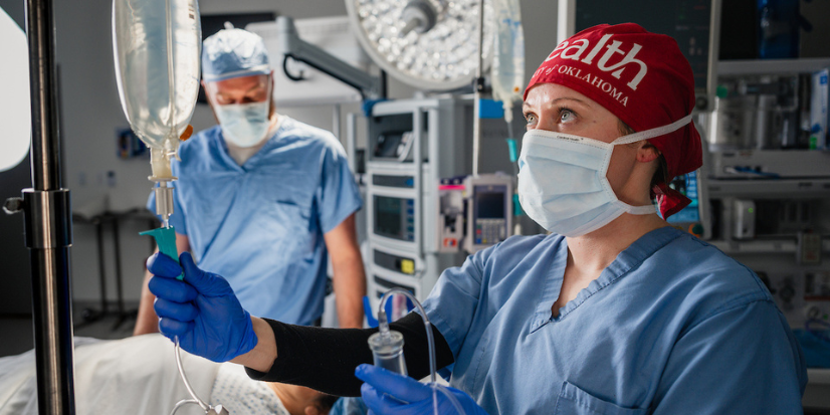
From the moment Caleb arrived, he was met by teams trained in emergency and trauma care. For Caleb, pediatric specialists took over. Pediatric orthopedic surgeon Dr. William Puffinbarger, M.D. (affectionately known as “Dr. Puff”), led the team that would spend the next several hours working to save the teen’s life and limbs.
“They don’t have time to calmly talk to you about things,” Lindsey said. “They’re in go mode. I felt like they were just like a swarm, a team of doctors.”
Caleb’s condition became even more dire when Lindsey briefly left his side.
“I only left him one time, and when I came back from the bathroom, my mom’s face was white. She [told me], ‘You need to get in there now.’ He had lost too much blood,” Lindsey said. “When I walked in, he literally made out the sound ‘mom’ and held his hand out. He had no color in his lips, in his face, in his entire body.”
That first night, Dr. Puffinbarger operated on Caleb’s femur (thigh bone) and knee, followed by arm surgery the next day. The next five days in the hospital, Caleb’s heart alarm would go off as his body struggled to cope with all the blood he lost. The team had to carefully balance giving him blood while allowing his system to adjust — one of many complex challenges they faced during his care.
“A Level I Trauma Center has specialized systems and personnel in place, demonstrating ongoing best practices in caring for injured patients,” explained Dr. Puffinbarger. Simply put, a Level I Trauma Center has proven it can provide emergency care for very serious injuries and conditions. Patients can rest assured they’re at a hospital dedicated to providing top-level care.
Healing the Family — Body, Mind, and Spirit
In addition to the medical expertise of a Level I Trauma Center is the commitment to caring for the entire family during the most traumatic moments of their lives. As Caleb’s doctors and nurses cared for him, other team members stepped in to support the Brumley family through the emotional crisis of those early days.
“Every single nurse that we had was amazing. Every single person, anybody that was on his team at Children’s, went above and beyond to not only take care of my son, but love on his mom as well,” Lindsey said, describing the comfort and compassion she felt. “I got so many hugs…. I felt like I wanted to adopt so many people from that place.”
When Lindsey hadn’t showered or changed clothes in five days, a staff member from the Ronald McDonald House (located on the OU Health campus) approached her gently.
“A woman came up and she said, ‘Sweetie, do you need some clothes and maybe a shower?’ That was the first time that I was like, ‘Oh, oh yeah, I probably do. I’m still wearing the clothes from the accident,’” she said.
The woman picked out clothes for Lindsey and brought her hair care products and a comb, small kindnesses that felt deeply meaningful.
Once stable, Caleb was moved to the trauma floor, where he began his long road to recovery. This is when the hospital’s Child Life Specialists stepped in, playing a key role in helping him cope with the fear and pain of his injuries. They organized games, arranged visits from characters dressed as superheroes, and rolled in an Xbox with a big screen. These distractions offered Caleb moments of joy during an otherwise difficult two-week stay.
“They were the people that you needed,” Lindsey said. “They went above and beyond their job by loving on me and my son. I can’t even describe how great they were.”
Rehab, Resilience and Prince the Therapy Dog
As Caleb’s recovery progressed, that same compassion and connection followed him. As he began physical therapy, one unlikely teammate made a lasting impact: a golden retriever named Prince.
Prince, a certified therapy dog with the hospital’s Paws for Purpose program, had only been on the job a few weeks when he met Caleb.
“Caleb and Prince connected right away,” Lindsey said. “The first time he met Caleb, his handler, Brittany, brought him in and said, ‘Big visit,’ which means get your whole body on the bed. But Prince wouldn’t ….”
But Prince didn’t get up on the bed at first. It’s as if he sensed Caleb wasn’t quite ready the close contact. Later, when the time was right, Prince climbed onto the bed and lay beside him, a quiet turning point in their bond.
“Dogs are crazy, awesome, magical animals, but he bonded with this boy instantly,” Lindsey said.
That bond continued after Caleb was discharged. Over the next year, as Caleb attended outpatient therapy twice a week at Oklahoma Children’s Hospital OU Health, the team made sure Prince was present for nearly all of Caleb’s physical therapy sessions.
The therapy staff became like family to the Brumleys, celebrating every hard-earned milestone.
OU Health orthopedic surgeon Dr. Charles Pasque, M.D., played a key role in helping Caleb regain range of motion in his knee.
“Dr. Puffinbarger involved me in Caleb's care after he had recovered from his acute injuries and developed a stiff knee,” said Dr. Pasque. “My primary role was to release and remove the scar tissue in his knee resulting from his previous injury and surgeries.”
Caleb progressed well, improving his range of motion from 0–30 degrees before surgery to 0–120 degrees afterward.
“Although he still has a lot of work ahead with our excellent physical therapy team, the increased range of motion has already improved his daily functioning,” said Dr. Pasque
Dr. Puffinbarger noted that OU Health’s team-based approach ensures patients receive coordinated, specialized care throughout every phase of healing.
The Road Ahead
A year after the accident, the Brumley’s journey continues. Caleb still faces additional surgeries, but the family meets each new challenge with confidence in the healthcare team supporting them.
“We just found out yesterday at an appointment with the new surgeon about two pretty extensive surgeries,” Lindsey said. “Basically, they’re going to have to re-break the knee [and] reset it. He’s going to have a leg lengthening procedure, so they have to re-break [the bone], stretch it out over a month period of time, and he probably won’t be walking until August.”
Dr. Puffinbarger, who continues to oversee Caleb’s care, said the boy’s injuries were incredibly complex.
“Although he healed his fracture and didn’t get infected, he developed a growth disturbance with leg length discrepancy and angular deformity due to growth plate injury, which is being addressed by surgery, including a magnetically controlled ‘growing’ intramedullary rod,” he said, adding that the surgery was performed by Oklahoma Children’s Hospital’s pediatric orthopedic surgeon Dr. James Gregory, M.D.
In other words, even though Caleb’s femur healed, the injury affected how his leg grew — it was shorter and slightly bent. His surgeon will re-break the bone and then insert a metal rod. Over time, the bone will be gradually straightened and lengthened.
Despite these long-term challenges, the Brumley’s are grateful for the care that brought Caleb through the crisis.
“I don’t think it would have turned out the same way anywhere else,” Lindsey said. “I’ve always heard if you want somebody to save your life, you go to OU Health because they will. They put my boy back together when it was against the odds.”
During Caleb’s time at OU Health, the nurses formed close bonds with the family. And even amid pain and uncertainty, Caleb found moments of lightness.
“My son even said, ‘You know what, Mom, this is kind of fun. Everybody here is so nice, I can play video games, the food’s really good here, and this is the most one-on-one time we’ve ever had,’” Lindsey said.
For families facing the unimaginable, the Level I Trauma Center at OU Health and Oklahoma Children’s Hospital OU Health provide more than expert care — it offers hope, stability, and the kind of support that stays with you long after the crisis has passed.
“We were where we were supposed to be,” Lindsey said. “There’s no doubt about that.”
Learn more about orthopedic services at Oklahoma Children’s and about trauma services at OU Health.