After Mysterious Vision Loss, OU Health Restored a Missionary’s Sight and Life
- Category: Blog
- Posted On:

Indy Stone stands before 46 children in Mexico, leading them in songs and choreography for Vacation Bible School. Her energy is boundless and her vision crystal clear, yet just two months earlier, she could barely see the arm of a person standing directly in front of her.
The troublesome symptoms started in December 2019, right after the birth of Indy’s youngest son, Josiah. But they made no sense to her.
“I was having anger spurts and lots of weird symptoms,” Indy recalled. “I’m not an angry person. I normally get along really well, but I realized I was just off.”
Her husband noticed the change too. Simple accidents that wouldn’t ordinarily bother Indy would send her into a rage. Spilled milk made her see red. A dropped toy would strain her composure. Her reactions were completely out of proportion. Something was clearly wrong.
Other symptoms followed. Crushing headaches — unlike any migraine she had experienced before — brought her to her knees. Unexplained weight gain changed her face beyond recognition. Extreme exhaustion caused her to fall asleep mid-conversation. And strangest of all, she had vision problems that seemed to come and go without warning.
“I was reading my Bible, and my vision got so messed up, it was almost like looking through cellophane paper,” Indy said. “I was getting mad because I thought, why can’t I read? This is not normal.”
As a translator and interpreter for her missionary work, reading was essential to Indy’s calling. Increasingly, she found herself staring at English words, knowing she needed to write them in Spanish, yet unable to make the connection in her brain.
The Breaking Point
For three years, Indy dismissed these symptoms. As missionaries, she and her husband kept busy, and he was battling his own health crisis with Lyme disease. She convinced herself it was stress or perhaps thyroid problems.
Then came February 5, 2024, during Wednesday night church service. Indy was walking down the hallway when her vision suddenly collapsed into a small tunnel.
“I could see somebody’s face, but around it was black,” she said.
In what Indy calls divine intervention, the next person she encountered was a family friend, who happened to be a pediatric ophthalmologist. She grabbed his arm in desperation.
“Doctor, something’s happening to my eyes,” she told him.
That doctor acted immediately, bringing Indy to his office to run tests and examine her eyes thoroughly till nearly midnight, with the doctor’s wife near her side for support.
“Your eyes seem perfect,” he told her afterward. “The problem is that your symptom specifically indicates that there’s something neurological going on.”
Racing Against Time
Indy was referred to a clinic for specialized testing. The next morning, a visual field exam revealed devastating news. She had lost more than half her vision, retaining only 46% of her sight in both eyes.
“Because of all the signs, it looked like I had a brain tumor,” Indy said. “They recommended that I go to OU Health.”
There, an MRI confirmed Indy’s fears: She had a 3.5-centimeter macroadenoma that was pressing against the optic nerves. Positioned directly above the pituitary gland, the tumor was crushing the optic chiasm where the nerves cross. Without immediate surgery, she risked permanent blindness.
Enter the Expert Team
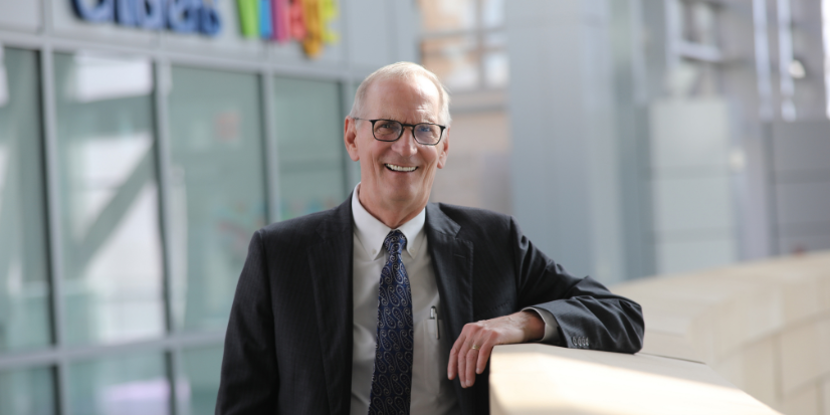
The next step in Indy’s care was neurosurgeon Dr. Ian Dunn, M.D., FACS, FAANS, professor and executive dean for the OU College of Medicine and chief physician executive at OU Health. He specializes in pituitary tumors and had performed thousands of these procedures.
“Fortunately, the type of tumor she had was benign,” Dr. Dunn said. “The growth rate of these tumors can be very, very slow, and even though they’re causing problems, it can be hard to recognize the symptoms early on.”
Pituitary tumors like Indy’s, he explained, are among the most common brain tumors in adults. Symptoms typically fall into two categories: pressure effects from the tumor’s size and hormonal disruption from the compressed pituitary gland.
“When you have something that big, things are being displaced to make room,” Dr. Dunn said. “There’s an incredible degree of chance for recovery of that vision."
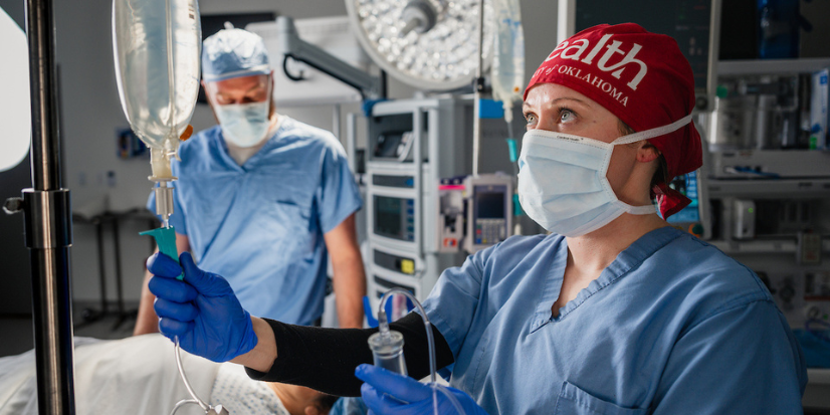
The surgery would be performed through the nasal cavity using advanced endoscopic techniques, avoiding traditional brain surgery.
“We’re actually not looking at the patient’s nose or face during surgery,” Dr. Dunn said. “We’re looking at a big, huge, high-definition monitor, just like laparoscopic surgery in other parts of the body.”
A Remarkable Recovery
On March 6, 2024, Indy underwent surgery at OU Health. As the procedure progressed, the medical team sent regular updates to her anxious family in the waiting room.
Hours later, Dr. Dunn emerged with the best possible news. The entire tumor had been removed in one piece, with no remnants left behind.
When Indy regained consciousness, her husband asked the question that had been weighing most heavily: “Can you see?”
“When he asked me that, it dawned on me, I could see,” Indy said. “I had regained the fullness of my vision instantly. I was able to see every single panel on the curtain in the ICU.”
The recovery that typically takes months happened much sooner than expected. In follow-up testing, Indy’s vision had improved from 46% to 96%.
“They said that’s not always the case,” Indy said. “Usually, it takes a period of months and you’re regaining your vision a little at a time. But in my case, the recovery has been phenomenal."
More Than Vision Restored
The surgery gave Indy back much more than her sight. The tumor had been compressing her pituitary gland, throwing her hormones and metabolism into chaos. She hadn’t had a menstrual period in four years, her weight increased, her face swelled, and her energy levels plummeted.
“My pituitary was squished,” Indy said. “Once they removed the tumor, it went back to function normally.”
Within six weeks of surgery, her hormone levels were back in balance. Her energy levels rebounded dramatically. The personality changes that had strained her family relationships disappeared.
“I was back to being a sweetheart,” she said with a laugh. “It was incredible the difference in my mood.”
Back to Her Calling
Just two months after surgery, Indy returned to her missionary work in Mexico with renewed purpose — leading Vacation Bible School for 46 children, running the music station at another Vacation Bible School, working with 100 kids for five days straight, and translating and interpreting with the sharp focus she once feared was gone forever..
“My energy levels were such that I never once thought, ‘I’m tired,’” she said. “It was incredible.”
Looking back, Indy realizes how close she came to losing not just her vision, but her ability to serve in the mission field she loves.
“OU Health literally gave me back my life,” she said. “My marriage, my family, my work. OU Health’s people became heroes to me because I had no clue what I was dealing with, but knowing that they did gave me complete confidence.”
Indy’s case highlights the importance of having access to specialized neurosurgical expertise. OU Health’s team performs more pituitary surgeries than any other center in the state, using advanced techniques that make complex procedures safer and more effective.
The team of neurosurgeons, ear-nose-throat specialists, endocrinologists, specialized nursing staff, along with Neurosurgery Clinical Nurse Specialist Kate McDaniel, APRN-CNS made the outcome possible, Dr. Dunn said,
“It’s not just me. I like to think I’m an important part of the team, but I certainly don’t do it alone,” he said.
For other patients facing similar diagnoses, Indy’s story offers hope and a reminder of the importance of seeking specialized care when symptoms don’t make sense.
“I finally felt like I wasn’t crazy,” she said. “There was literally something physically wrong, and these experts knew exactly what they were doing.”
Learn more about OU Health’s multidisciplinary approach and commitment to patient-centered care in treating complex conditions like pituitary tumors at OU Health Stephenson Cancer Center.